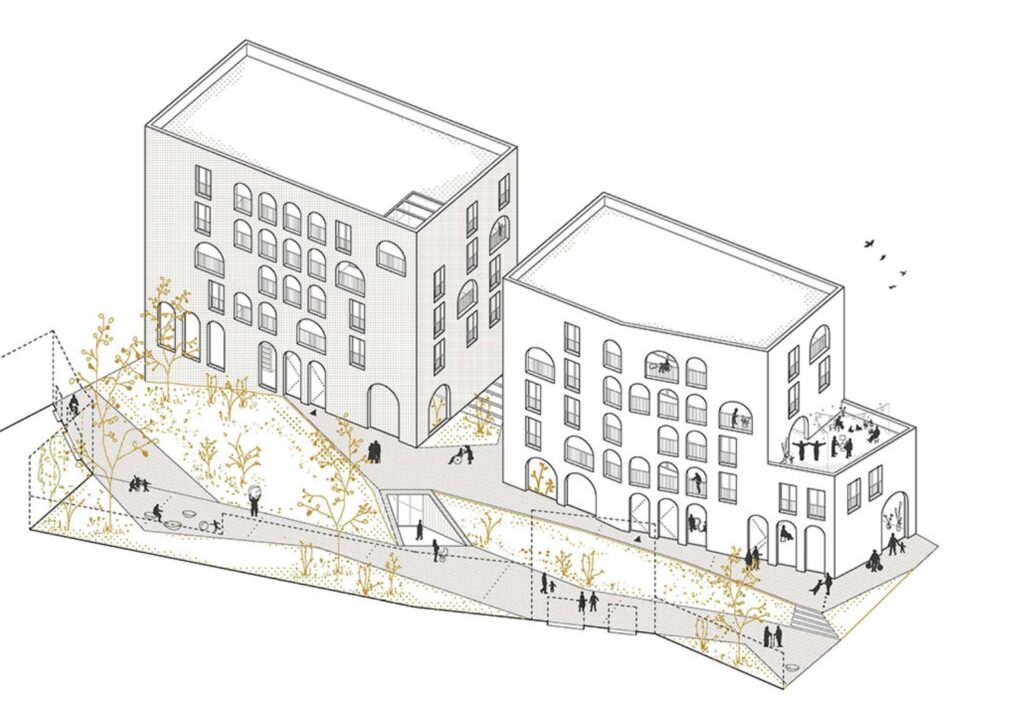
Can 70. Cooperative housing…and healthy!
We continue to provide consultancy for some of the projects promoted by Sostre Cívic, a pioneering organization in the country in fostering cooperative housing under a right-of-use (cession-of-use) model since 2004. Established as an association, it has become a participatory space for a number of people who, on a voluntary basis, seek to promote an alternative way of accessing and holding housing in Catalonia.
In this case, we had the opportunity to work with the development promoted by a group of older adults, “Can 70”. As we read on their website: Can 70 is a group of older people working towards active ageing within the framework of cooperative housing under a right-of-use model, conceived as an alternative to the current model of ageing.
In addition to choosing this cooperative right-of-use housing model, this group of cooperative members has also ensured that the project incorporates health criteria. This is where our cooperative came in: we analyzed the site’s initial conditions through measurements, and we monitored both the basic design and the detailed executive project by the architecture firm Peris+Toral, winners of the competition to design the new building.
The fact that the building’s user community will be made up of people over 70 has meant that wellbeing, comfort, and health parameters are adjusted to the specific needs and requirements associated with age.
For example, regarding lighting conditions, visual capacity decreases as people get older. Less light reaches the retina. Perception of color and depth is reduced, while the eyes’ ability to adapt also worsens. This means that lighting must be designed with the characteristics of the users in mind.
With regard to age-adapted lighting, at a preliminary level the following should be considered:
a) Increase ambient lighting levels (lux): approx. 50%
b) Increase task lighting levels in work areas: approx. 3×
c) Avoid glare
d) Increase contrasts (not brightness contrasts). For example, between a staircase and the adjacent wall.
e) Harmonize differences in light intensity between adjacent spaces.
Some of the other aspects assessed were:
Alternating magnetic-field pollution. Control the distance to the sidewalk where electrical cabling has been detected with values above recommended levels, and if a transformer substation (ET) is ultimately installed, control its distance from bedrooms.
Presence of radon gas. We are in Zone I and, therefore, the protection required by the Spanish Building Code (CTE) and considered sufficient is a protective barrier or a ventilated air cavity. The project proposes a protective barrier.
Acoustic environment. Barcelona’s environmental data map warns of sound levels above recommended values on the façade facing Via Augusta; strategies are already being developed to reduce them, especially in nighttime rest areas.
It is recommended that, for the façade facing Via Augusta, the most unfavorable design value be used:
Façade noise level / total daytime noise: 75 dB(A)
Façade noise level / total evening noise: 70 dB(A)
Façade noise level / total nighttime noise: 65 dB(A)
Air quality. Barcelona’s environmental data map provides information on outdoor air quality: due to high traffic density, on many days NO₂ levels are up to 4 times higher than WHO recommendations. This is another aspect we can improve through the building’s design.
As for indoor air quality, it is important that paints are mineral-based. In this case, lime paints have been proposed—an excellent option if the aim is to ensure they do not contaminate the air, to respect the substrate’s breathability, and to promote the hygroscopic properties of the materials.